Friday, May 30, 2014

Hearing Aids and Noisy Distractions

You may have noticed that folks who wear hearing aids are more easily distracted by noise than those not wearing them. I know, it sounds odd...but it's true. Here is a simple explanation for why hearing aid users are sensitive to loud noises. As you read this, I want you to be aware I am not talking about hyperacusis. You can read all about it here. Back to the simple explanation...

While hearing aid clarity has much improved over the years, hearing aids still amplify the sounds we hear. You may not believe me, but I can usually tell you the instant the HVAC comes on in the room, and it's all I hear from that point on. If we are in the middle of a conversation, then that's just plain annoying because I see the person's mouth moving, but all I hear is that stinking HVAC.

In the classroom, if you notice a hearing aid user distracted, consider what noises are currently audible and eliminate them as best you can.

Thursday, May 29, 2014

Daily Classroom Challenges

I've developed an easily referenced chart that lists the five biggest classroom challenges learners with hearing loss face in the classroom.  Keep in mind this chart does not apply to all learners with hearing loss as there is no one measure that encompasses the DHH population. This is based on my observations as a teacher as well as my personal experiences growing up in a mainstream, public school environment. If you would like for me to send you the attachment, send me an email.


Challenge
Reason for the Challenge
Solution to the Challenge
Classroom discussions


Students with hearing loss, most times, can’t understand people speaking if they can’t see them. Hearing loss causes distorted speech. Students with hearing loss can’t tune out background and distracting noises like hearing people can. People with hearing loss need to see you speaking in order to get best access to oral information.
*Arrange specific times for classroom discussions.
*Change your seating to reflect a U pattern with you standing in the open space and facing the students.
*Don’t allow students to talk without raising hand and waiting a second to speak.
*Don’t speak with your back towards the students.
Students talking out of turn


Read above. The speed of sound is quicker than a human’s reflexes. The person with hearing loss needs to have a visual in addition to listening to ensure best access to oral communication.
*Make students raise hands and then call on the student before having them speak.
*Repeat the students’ questions and give your answers to them.
Teaching in front of lights


Several people with hearing loss can read lips and use it to give them an aide in helping them understand what is said. Bright lights creating a halo around you make it very difficult for students to read your lips. This goes for windows as well as lighting fixtures. Do not have the light source coming behind you.
*If you have control of your lighting in the classroom, dim it down. A hearing loss can cause an overloaded sensitiveness towards light as the brain is trying to compensate for the hearing loss.
*Make sure you distance yourself from windows during instruction.
Giving notes


It’s impossible for students with hearing loss to listen to you and take notes since they need to see your face and they can’t see you and the paper at the same time.
*Do not talk while giving notes.
*Make your notes as specific as possible.
*Do not add oral information to be included with the notes. Write everything down.
*If you give your notes orally, make sure the student with hearing loss gets a written copy.
Trying to enunciate speech/highlighting the student’s hearing loss


Hearing loss is much more of a clarity problem than a volume one. You don’t have to yell or increase your voice. Most times, If changes need to be made, they need to be made to increase clarity. If you are soft spoken, you will have to speak up. Oftentimes, students with hearing loss are uncomfortable with their disability.
*If you are a woman, wear lipstick. If you are a male, either shave or trim your facial hair. *Decrease classroom noise as much as possible (for example, avoid using HVAC during instruction.
*If you have issues concerning your students with hearing loss, address them in private.

Tuesday, May 27, 2014

How to Read to a Child with Hearing Loss

How do you read to a child who hears fine? If you read like there's no problem, then that's how you read to a child with hearing loss. Trust me, there is no problem with the child reading other than the fact he can't hear. Yes, there will be delays in reading because of the hearing loss, but you shouldn't try to dumb down the material or leave out the idioms for the sake of difficulty. Expose the child to as much literature as you can. Read often, re-read and then read again! Don't dumb anything down or leave anything out. Don't treat hearing loss as a stumbling block since it isn't one. Not only is Garfield tons of fun; so is reading!


Monday, May 26, 2014

Friday, May 23, 2014

Cued Speech (CS)-The Good, The Bad, and The Ugly

The Good-CS is a good supplement to the English spoken language.

The Bad-CS is not a language on its own like ASL-it's only a supplement to the spoken  language.

The Ugly-the population of CS users is very low. I've only had one student use it in 7 years of teaching, and I've never seen it in use anywhere else.

I'm not bashing CS at all; I don't bash any form of communication (except maybe "home sign language"-that's another story and another post). Let the child choose his/her own communication method, but make sure you use spoken language as the primary mode of communication and teach CS as a supplemental measure...Not the other way around.


School is close to being out for the summer, so my blogs will stop next week. If you wish to email me feel free to do so.


Thursday, May 22, 2014

How to Correctly Implement Preferential Seating Accommodations in IEP


In my professional experience, the best way to implement the accommodation is to allow the student in question to determine his own best placement in the classroom. It doesn't necessarily have to be seated in the front row right in front of the teacher. If the student wears a hearing aid and the teacher teaches next to the HVAC system, then that placement would quite possibly be the worst placement.

If working with a young student, make the decision for him. If teaching an older student who is responsible and eager to learn, let him make his own decision (include a disclaimer that you'll relocate him as soon as distractions occur.)

Students with HL need specific accommodations (unobstructed view of speaker's face, sound systems, peer-buddy within reach, etc). Allowing the student to pick his own placement will alleviate much of this and make your life much easier. After all, it's best (and easiest) when the student holds himself accountable for his own learning.

Email me if you have  any further questions or would like to discuss this in-depth.

Wednesday, May 21, 2014

Pre-lingual vs Post-lingual Hearing Loss

Pre-lingual Hearing Loss (HL) is HL before the acquisition of speech. Post-lingual HL comes after the access to speech. I'm pre-lingual since I've been deaf all of my life. I run into a lot of folks that lose hearing after they've acquired a mastery of the English spoken language and I know the pain they feel. I don't understand it fully since I didn't lose my hearing later in life, but I know about the challenges that will be faced. I imagine it would be much harder to have normal hearing thresholds reduced since the person would know what he/she is missing out on. The most important thing to remember is not to let the hearing loss define oneself. One good thing about folks with HL- they don't have to listen to negativity.

Tuesday, May 20, 2014

History of Hearing Aids

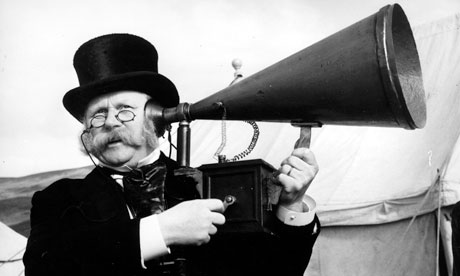
If you've ever wondered how we've (hearing aid users) come to this point, click here to read a Wikipedia article on the subject. It's very interesting. I am glad I don't have to use an ear trumpet!!!


Monday, May 19, 2014

Dreams Made Real

Click here to watch a terrific video. It is 23 minutes long, and well worth the viewing.

Friday, May 16, 2014

Reading and Hearing Loss Statistics

Did you know there's a statistic that shows the average 18 year old with hearing loss to be comparable to a 9 year old hearing reading ability...or something along those lines...maybe I'm not even remotely close. Does it matter to me? Not at all! I read and write very well. I'm a human being that happens to have a hearing loss-one thing I am not is a statistic. Don't get me wrong, I read statistics a lot and they are very useful to me in the education of students with hearing loss. I use them to guide my teaching so I can be a better teacher to my students. Don't let the statistics define you. Don't let the hearing loss define you. You are who you are; a person created by God and made perfect in His eyes.

Thursday, May 15, 2014

Be YOURSELF!

I just finished up this devotional by Rick Warren. On day 16, the topic of his devotional was, "how to be yourself, not someone else." He started off by quoting Romans 9:20. I was reminded of my youth days in which I heavily questioned God's intent to create me as a deaf human being. Why did He do that? I believe the answer can be found in Ephesians 4:7...We all have specific gifts given to us by God and He intends us to glorify Him by using our gifts to allow Him to work in us and through us. Don't question God for making you who you are; thank Him and seek ways to use your gifts through prayer. After all, who are we to question the One who created us perfect in His eyes??

Wednesday, May 14, 2014

I Am Deaf And Unashamed

I've been deaf (not to be confused with Deaf) all my life. I've had a few run-ins with low self-esteem and sensitivity to my hearing loss. Others, like me, have faced the issue. How do we cure our "anger" towards having a hearing loss? Here's what to do and how to do it...

You must accept your disability. Yup, you must do it. How? That's easy to do when you read your Holy Bible and have a personal relationship with God. Only He can give you the peace needed to personally get over your hearing loss and realize it is a blessing only He can provide.

The world is full of sugar. We are quick to praise the good things and ignore the bad things. It's like cotton candy; It tastes, looks, and smells good. Many folks consider hearing loss of any degree to be a bad thing. I'm here to tell you it isn't. You must believe it for yourself before any progress can be made.

Tuesday, May 13, 2014

National Board for Professional Teaching Standards

I submitted my NBPTS portfolio at 9:45am today. I've spent a long and hard year working on this. I pray that I will pass the first time around. If I don't, I'm not worried-I know that I will pass. This is just another challenge that I have faced and will beat eventually. One of the best parts of being deaf besides knowing that God made me just how He wanted me to be is the fact I don't have to listen to naysayers. You may tell me I can't do something but it won't faze me; I've been told "no" all my life and I'm still standing, fighting, and succeeding.

Friday, May 9, 2014

What's the difference?

I wear a Hearing Aid (HA) every day in my right ear. I have to-I can't hear anything at all without it and I have no hearing ability in my left ear. I wear it all the time (only when I am not in water or asleep). I know the advantages my HA offers me because it's part of me. Literally, when I die, my HA will be buried with me! As a teacher of students with hearing loss, I am often asked the question, "what's the difference with my hearing aids (HAs)?" 9 times out of 10 these are students that can hear without the HAs in (mild or moderate hearing loss) and they do not habitually wear them.

The HA user will not be able to tell any difference until the user has been habitual in wearing them often. Unless they are worn all the time, no difference will be detected. For example, a person may be able to hear the birds chirping or the TV come on with the HAs in, and notice they can't hear the sounds without them in. You don't know what an iPad can do for you unless you use it daily. Same applies for HAs. What's the difference??? It's huge! Only the user can know after they have routinely worn them.

Thursday, May 8, 2014

I posted yesterday on the subject of health insurance mandates and hearing aids. Click here to see what SC is doing to get insurance coverage of young hearing aid users. I firmly believe that all hearing aid users should be afforded hearing aid coverage, regardless of age and degree of hearing loss. Just ask yourself, "what would I want if I, or my child, had a hearing loss?" I'll go ahead and answer for you-one thing you'd want is to see hearing aids/cochlear implants covered by insurance.

Wednesday, May 7, 2014

Click here to check out which states in the US currently offer health insurance mandates for hearing aids and/or cochlear implants. South Carolina is not currently on the list. That needs to change!

 There are certain unalienable rights for all Americans: life, liberty, and the pursuit of happiness. As a hearing aid user myself, I can personally attest to the fact that my hearing aid increases my own quality of life. Money should not stand in the way of anybody's pursuit of happiness.

Thursday, May 1, 2014

Cochlear Implants in the Classroom

Click here for good information about the benefits of cochlear implants in the classroom.

Lip-Reading: The Good, the Bad, and the Ugly

While the art of speech reading is beneficial to people with hearing loss, it is not meant to be used as a stand alone method of communication-it should just supplement the primary method of communication (oral language, sign language, or both). This mainly pertains to people with hearing loss who have access to speech via hearing aids or cochlear implants.

Good-when used in conjunction with listening, speech-reading can really enhance your understanding of information presented orally by the speaker.

Bad-if you rely on speech-reading you can lose your listening skills. Make sure you make the most effort to listen while speech reading.

Ugly-if you rely on speech-reading alone you are only getting about 30% of oral infomation-40% at most!